Bevorstehende Veranstaltungen & Aktivitäten
Webinarreihe »Bidirektionales Laden«: Infos und Anmeldung hier
Rückblicke & Ergebnisse zum Download
Assessing bidirectional EV charging for employer parking: A case study of the MAHLE chargeBIG demonstrator in Stuttgart
Highlights
-
Real-world study on vehicle-to-grid / bidirectional charging in an industrial setting using MILP.
-
Break-even compensation value of €0.66 – €1.78 per discharged kWh via peak shaving and demand response.
- Energy arbitrage was non-viable due to electricity prices, user constraints, and battery degradation.
- Average savings ranged from €211 – €893/EV/yr, depending on scenario and availability.
- EV availability was a more critical driver for cost savings than battery capacity.
Abstract
This paper investigated the economic and operational viability of bidirectional charging (BC) technology through a real-world case study of the MAHLE chargeBIG demonstrator in Stuttgart, Germany, which is equipped with 101 electric vehicle (EV) charging points in the company car park. Using empirical charging data recorded in 2023, a mixed-integer linear programming model was developed to optimize energy costs, self-consumption, and renewable energy integration through price-based demand response (DR) with quarter-hourly market prices, while accounting for battery degradation effects and infrastructure investment costs. This research aimed to provide actionable insights for companies considering the adoption of BC technology by quantifying its economic and operational impacts under realistic industrial conditions. The results indicated that, depending on the scenario and context, BC achieved a break-even compensation value of €0.66 – €1.78 per discharged kWh (excluding battery degradation) through peak shaving and price-based DR. Correspondingly, the maximum annual saving per EV at the company level varied between €610 and €2,018 with average savings of €211 – €893/EV/yr, depending on the specific scenario and vehicle availability. Moderate increases in charging station power, from 7.2 kW to 11 kW AC or from 10 kW to 20 kW DC significantly enhanced cost efficiency and operational flexibility, while a further increase to 30 kW DC provided negligible additional benefits. The findings suggest that, under our applied market conditions and system constraints, energy arbitrage on the electricity market was not economical due to user constraints, prevailing price structures, and the impact of battery degradation. In this study, the primary economic benefits of BC in company settings were found to stem predominantly from peak load reduction, alongside a 22% decrease in degradation costs, and variable price-based DR, positioning BC as a key enabler of cost-efficient and flexible energy management in industrial environments.
Juli 2026
E-Flotten als Energiespeicher nutzen: Praxisbeispiel aus der Industrie
Wie können E-Autos in Unternehmen nicht nur geladen, sondern auch als flexible Energiespeicher genutzt werden? E-Autos können in Unternehmen mehr sein als reine Verbraucher: Mit bidirektionalem Laden werden sie zu flexiblen Energiespeichern. Das Gute daran: Das ist keine Zukunftsmusik, sondern schon heute für Industrieunternehmen mit E-Flotte möglich. Im Forschungsprojekt BiFlex-Industrie haben wir gezeigt, wie rückspeisefähige Fahrzeuge helfen können, PV-Strom besser zu nutzen, Lastspitzen zu reduzieren und den Netzbezug intelligenter zu steuern.
Mai 2026
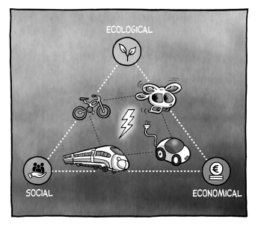
Kategorien und Anwendungsfälle zum bidirektionalen Laden von Elektrofahrzeugen
Mai 2025
Hier geht es zum LinkedIn-Beitrag
The 38th International Electric Vehicle Symposium & Exhibition
Thema: Integration of Nowcasting in Electric Vehicle Charging Infrastructures
Wann: 15. – 18.06.2025
Wo: Göteborg, Schweden
… zur BiFlex-Publikation hier klicken
„Short-Term Utilization Forecasting of Electric Vehicle Charging Infrastructures“
Tagung Zukünftige Stromnetze 2025, Berlin
Thema: Bidirektionale Fahrzeugflotten in Unternehmen: Ergänzung oder Bedrohung für Batteriespeicher?
Wann: 29. – 30. Januar 2025
Wo: Berlin
BiFlex-Beitrag in der Posterübersicht 2025 / Energiewirtschaft
Referentin: Michelle Antretter, Fraunhofer ISE

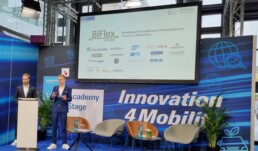
Vortrag zum Projekt BiFlex-Industrie auf der Automechanika Frankfurt
Thema: Wie Unternehmen durch die Integration bidirektionaler Fahrzeugflotten neue Flexibilitätspotenziale erschließen können
Wann: 11. September 2024
Wo: Messe Automechanika Frankfurt
Auf der Automechanika 2024 in Frankfurt, der internationalen Leitmesse für den Automotive-Aftermarkt, stellten David Meyer und Luca Husemann von der Universität Duisburg-Essen das Forschungsprojekt BiFlex-Industrie vor. Neben dem Potenzial des bidirektionalen Ladens im Unternehmensumfeld und dem Inhalt des Projektes wurden die Forschungsergebnisse aus der durchgeführten Mitarbeiterbefragung präsentiert. Der Vortrag ist als Video verfügbar.